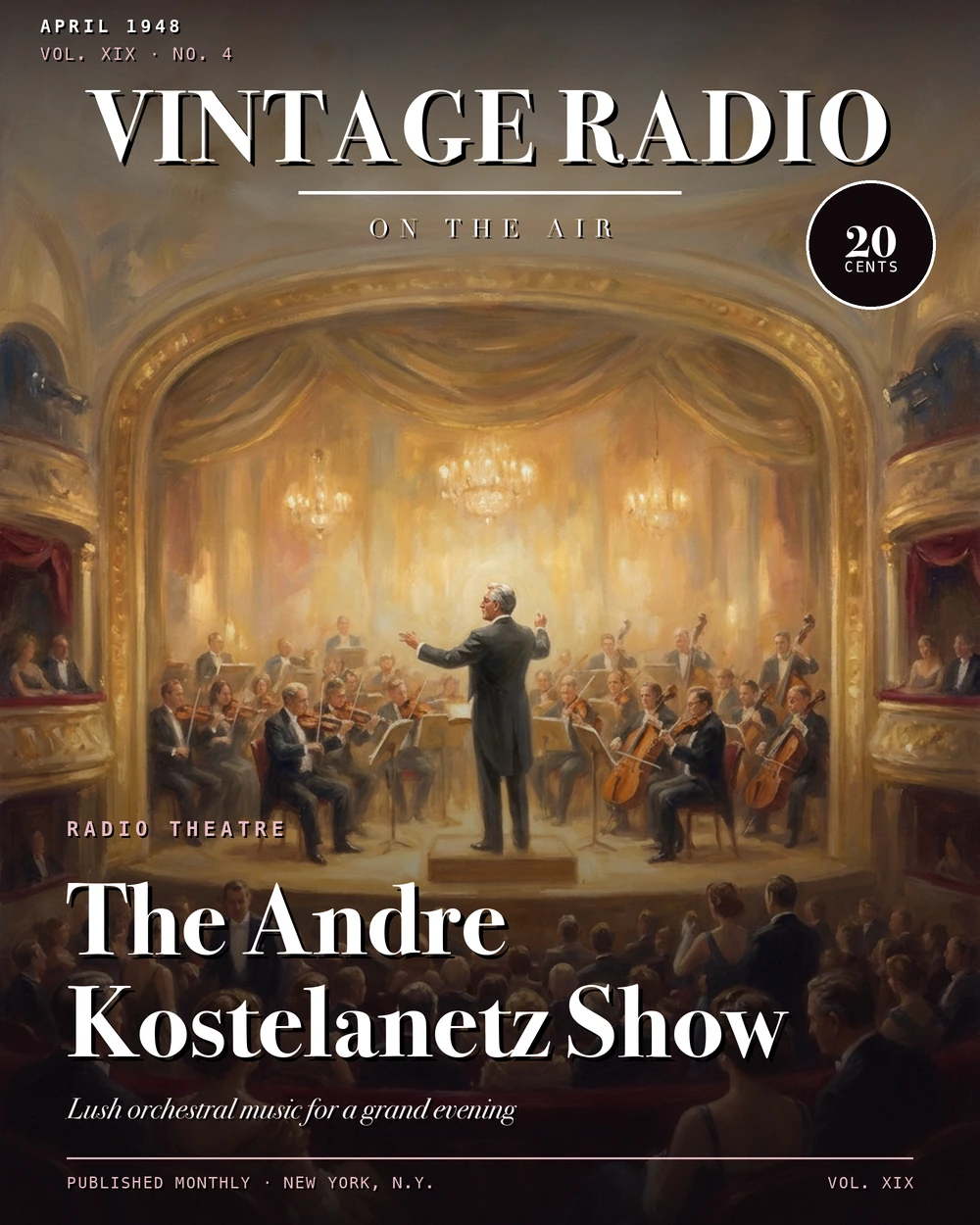
The Andre Kostalanetz Show
The Man Behind the Orchestra
André Kostelanetz arrived in the United States in 1922, having fled Russia after the Revolution. He became a citizen in 1928, and he had made his radio debut as an orchestral conductor a few years earlier, in 1924. By 1929 he had joined CBS Radio as an arranger and conductor for their staff orchestra, and through the 1930s he built a reputation as someone who understood the medium in a way many classical musicians didn't. He grasped early that radio and recording could carry music to audiences no concert hall ever could — and he acted on that instinct, assembling what was at the time the largest orchestra in radio: 65 pieces, performing under his name on the program Andre Kostelanetz Presents.
His earlier CBS work had been sponsored by some of the biggest corporate names in American advertising — Liggett & Myers Tobacco on The Chesterfield Hour, Coca-Cola on The Pause That Refreshes, Ethyl Gasoline on Tune-Up Time, and Chrysler on Music Millions Love. By the time The Andre Kostalanetz Show began airing in late 1944, he was one of the most established musical presences on American radio.
The Sound He Built
What made Kostelanetz's orchestra sound the way it did wasn't just scale — it was method. He doubled instruments in unconventional ways, having a flute also cover the saxophone part, an oboe double the English horn, a double bass take on the tuba. The result was a lush, harmonically dense texture specifically optimized for the limitations and qualities of radio broadcast. It wasn't classical music dressed up for mass consumption, and it wasn't pop with orchestral window dressing. It was something worked out carefully for the microphone.
He was also a pioneer on the technical side of radio production, paying close attention to microphone placement and recording techniques at a time when most conductors left that to the engineers. He actively promoted the value of recording engineers as collaborators rather than functionaries. That sensibility carried over into his work for Columbia Records, where he recorded extensively from the 1940s through the 1970s and eventually sold more than 50 million copies across his career.
The Guests Who Appeared
The surviving episode catalog from 1944 to 1946 gives a clear picture of the caliber of performers Kostelanetz brought in. Tenor Frank Parker, who had sung with Kostelanetz on WABC broadcasts in the early 1940s and was widely known through his associations with Jack Benny and Arthur Godfrey, appeared on the December 3, 1944 broadcast. Perry Como, then a rising CBS Radio star whose own Chesterfield Supper Club had launched that same year, also guested during the run.
Soprano Eleanor Steber — one of the first major opera singers trained entirely in the United States, and a Metropolitan Opera performer from 1940 onward — brought operatic weight to the program alongside popular and concert performers. Ginny Simms, who had made her name as the featured vocalist on Kay Kyser's Kollege of Musical Knowledge and hosted her own NBC show during the war years, represented the big band world. And Lily Pons, the celebrated French-American coloratura soprano who performed nearly 300 times at the Metropolitan Opera between 1931 and 1960, appeared in 1946 — she was also Kostelanetz's wife, having married him in 1938.
What Survives
The episode record currently documents seven broadcasts, running from late 1944 through February 21, 1946. Other research suggests the surviving record extends at least into April 1946, with additional guests including Gladys Swarthout, Kenny Baker, Lanny Ross, and Ethel Smith. The full picture of the run is almost certainly incomplete.
Beyond the radio episodes, Kostelanetz's broader legacy is well documented. The Library of Congress holds his collection — roughly 150,000 items covering more than 50 years of work, including orchestral arrangements, correspondence, scripts, cue cards, photographs, and radio broadcast materials. He commissioned significant works from American composers during this period, among them Aaron Copland's A Lincoln Portrait, which premiered May 14, 1942 with the Cincinnati Symphony, as well as Jerome Kern's Portrait of Mark Twain and William Schuman's New England Triptych. After radio, he went on to lead the New York Philharmonic's Promenade series at Lincoln Center. He died on January 13, 1980, in Port-au-Prince, Haiti, after contracting pneumonia following his final concert — A Night in Old Vienna, with the San Francisco Symphony — on New Year's Eve 1979.